
OEM vs. ODM E-Bikes: Which Manufacturing Model Is Right for Your Business?
The short answer: OEM is usually the better choice when your business needs a highly differentiated e-bike with specific technical requirements, while ODM is often more practical when speed, lower development risk, and a proven product platform matter more. For many new brands and fleet operators, the best route can be to start with an ODM platform and gradually move toward deeper OEM customization.
For businesses entering electric bike manufacturing, the choice between OEM vs ODM e-bikes affects development cost, launch timing, product differentiation, and long-term scalability. The right model depends less on which option sounds more advanced and more on what the business actually needs to build, test, and sell.
What Is the Difference Between OEM and ODM E-Bike Manufacturing?
Although OEM and ODM are sometimes used interchangeably, they involve different levels of product development responsibility. Understanding that distinction helps buyers choose a manufacturing model before committing engineering resources or production volume.
What Does an OEM E-Bike Manufacturer Do?
An OEM e-bike manufacturer typically develops or produces a product according to the buyer's specifications. The brand may provide its own product concept, design requirements, technical specifications, branding, or functional targets, while the manufacturer contributes engineering, prototyping, production, testing, and manufacturing expertise.
With e-bike OEM, the customer generally has greater control over the final product. This can include frame geometry, electrical architecture, battery configuration, components, accessories, appearance, and other market-specific requirements.
For businesses pursuing a custom electric bike manufacturer, OEM can therefore offer stronger product differentiation. However, greater customization usually means more engineering work, validation, tooling, and coordination before mass production.
How Does ODM E-Bike Manufacturing Work?
An ODM e-bike manufacturer develops an existing product platform that can be adapted for different customers. Instead of developing every component from the beginning, the buyer starts with a manufacturer-developed design and selects or modifies suitable elements.
This makes e-bike ODM particularly useful for brands that need to launch relatively quickly. Depending on the manufacturer, customization may cover brand identity, colors, decals, accessories, components, packaging, and selected functional features.
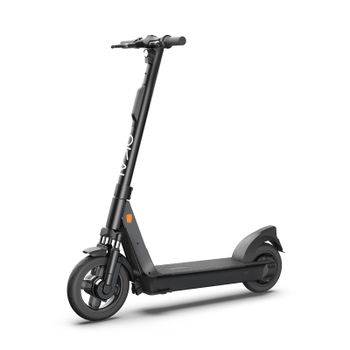
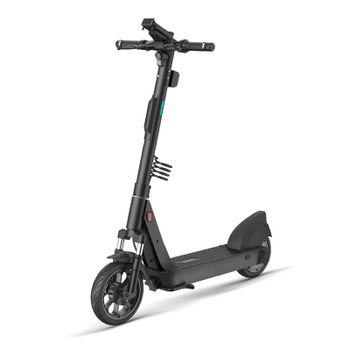
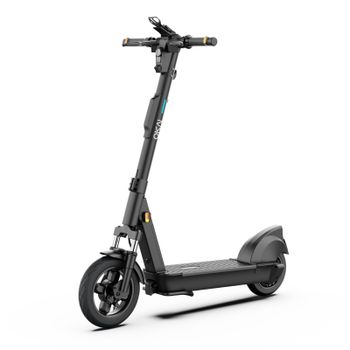
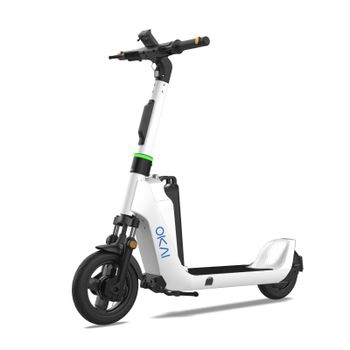
OKAI's B2B electric-bike business specifically supports OEM and fleet-ready customization, including options such as frame colors, logos, wheels, lighting, and accessories. For a broader overview of what to look for when evaluating a commercial e-bike manufacturer, see how to choose the right e-bike manufacturer for bulk orders.
OEM vs. ODM E-Bikes at a Glance
| Factor | OEM E-Bikes | ODM E-Bikes |
|---|---|---|
| Product development | Buyer-led or jointly developed | Manufacturer-led platform |
| Customization | High | Moderate to high |
| Development time | Usually longer | Usually shorter |
| Engineering input | Extensive | More limited |
| Product differentiation | Strong | Depends on available options |
| Development risk | Higher | Lower |
| Best suited for | Established brands, specialized products | New brands, distributors, fleet operators |
OEM E-Bikes: When Does Full Customization Make Sense?
OEM becomes attractive when the product itself is an important part of the company's competitive strategy. It is not simply about making an e-bike look different; the additional development work should solve a meaningful business or user requirement.
When Your Business Has Specific Product Requirements
OEM makes sense when an off-the-shelf platform cannot meet important requirements. These might involve rider ergonomics, cargo capacity, battery configuration, connectivity, fleet hardware, local regulations, or specialized accessories.
For example, a delivery company may need a particular cargo configuration, while a shared-mobility operator may prioritize battery-swapping efficiency and serviceability. In these situations, a custom development process can create a closer match between the vehicle and its operating environment. For more on what fleet operators should consider when specifying vehicles, see how to choose the right e-bike for fleet and shared mobility programs.
Regulatory requirements should also be considered early. In the EU, for example, electric bicycles outside the 25 km/h and 250 W continuous-rated-motor thresholds can fall under type-approval requirements under Regulation (EU) No 168/2013.
When Product Differentiation Is Part of Your Brand Strategy
For a brand competing primarily through unique product design or functionality, OEM can create a stronger barrier against direct product comparison.
A distinctive frame, proprietary configuration, specialized accessories, or integrated technology can make the product more recognizable than a standard private label e-bike with only a different logo and color scheme.
However, customization should have a commercial purpose. Adding unique features simply because they are technically possible can increase development complexity without necessarily improving market performance.
When You Can Support a Longer Development Cycle
OEM is better suited to businesses that can invest time in requirements definition, prototyping, testing, revisions, and production validation.
This matters particularly for safety-critical systems. The U.S. Consumer Product Safety Commission has emphasized compliance with applicable voluntary e-bike safety standards, including UL 2849, because electrical-system failures can create serious fire and injury risks.
A capable custom electric bike manufacturer should therefore be evaluated not only for its ability to build a prototype but also for its testing, documentation, quality-control, and production capabilities.
ODM E-Bikes: When Is a Faster Go-to-Market Strategy Better?
For many businesses, the biggest challenge is not creating a completely original e-bike. It is bringing a commercially viable product to market without taking unnecessary development risks.
When You Want to Launch an E-Bike Product Faster
ODM reduces the amount of product development required because the manufacturer has already invested in the basic platform.
Instead of beginning with a blank sheet, a business can evaluate an existing model, identify required modifications, complete branding and validation, and move toward production. This can be especially useful for startups and distributors testing a new market.
When a Proven E-Bike Platform Meets Your Needs
If the existing architecture already satisfies the major requirements, ODM may provide a better balance between customization and efficiency.
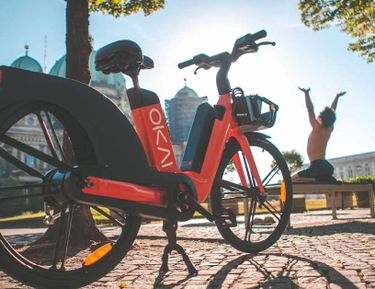
For instance, OKAI's EB001 shared electric bike is built around a modular design and side-access battery system. Its listed specifications include a 70 km claimed range, 25 km/h maximum speed, 250 W rated power, and 500 W maximum power. For more on how the EB001's battery design supports fleet operations, see e-bike battery swapping: what fleet operators should know.
A platform with established engineering and manufacturing experience can be more practical than developing equivalent functions independently, particularly when the intended use case does not require proprietary hardware.
How ODM Can Reduce Product Development Risk
The main advantage of e-bike ODM is not simply lower development cost. It can also reduce uncertainty around engineering, sourcing, prototyping, and production transfer.
A manufacturer with established product platforms can apply existing supplier relationships, manufacturing processes, testing procedures, and technical knowledge. This does not eliminate risk, but it can reduce the number of variables a new buyer must manage.
OEM vs. ODM E-Bikes: How to Choose the Right Model for Your Business
The choice between OEM vs ODM e-bikes should be based on three practical questions: how different the product needs to be, how quickly it must launch, and what role the product will play in the company's long-term strategy.
Consider Your Product Customization Requirements
Start by separating essential customization from cosmetic customization.
If you mainly need branding, colors, packaging, and selected accessories, ODM may be sufficient. If you require substantial changes to the frame, electrical system, battery architecture, software, or vehicle functionality, OEM is more appropriate.
Consider Your Time-to-Market Goals
If entering the market quickly is a priority, ODM usually has an advantage because much of the platform development has already been completed.
By contrast, OEM requires more time for engineering and validation. That additional time can be justified when the resulting product has a clear competitive advantage.
Consider Order Volume and Long-Term Product Strategy
Order volume should not be evaluated in isolation. Consider whether the e-bike will become a long-term core product.
A business planning a limited market test may prefer ODM. A company building a large fleet or establishing a proprietary product line may benefit from investing in OEM development.
Decision Table: OEM or ODM?
| Business Situation | Better Fit |
|---|---|
| Need a product quickly | ODM |
| Mainly need branding and appearance changes | ODM |
| Want to test a new market | ODM |
| Need specialized technical features | OEM |
| Product differentiation is central to the brand | OEM |
| Planning a long-term proprietary platform | OEM |
| Uncertain about market demand | Start with ODM |
Can You Combine OEM and ODM Strategies?
Yes. The two approaches do not have to be permanent alternatives.
Starting With an ODM Platform
A new brand can begin with an ODM product to validate pricing, customer demand, distribution channels, and operating requirements.
This approach allows the business to learn from actual market feedback before committing to a larger engineering program.
Moving Toward Deeper Product Customization
Once the product has demonstrated demand, the business can identify which elements deserve further investment. The next generation may introduce a customized frame, battery system, accessories, connectivity features, or other proprietary elements.
This staged approach can combine the speed of e-bike ODM with the differentiation of e-bike OEM, while spreading development investment over time.
Choosing the Right E-Bike Manufacturing Partner
Choosing between OEM and ODM is only half of the decision. The manufacturer's engineering depth and long-term support can determine whether the selected model actually works in production.
Manufacturing Experience and Product Capabilities
Look for evidence of manufacturing experience, product testing, production capacity, and experience serving international markets. OKAI has 14 years of manufacturing experience and an R&D team covering areas including IoT, BMS, ECU, software, and vehicle platforms.
The manufacturer should also understand the requirements of commercial applications rather than focusing exclusively on consumer products.
Customization and Engineering Support
A strong OEM e-bike manufacturer or ODM e-bike manufacturer should be able to explain exactly which elements can be customized, which require engineering changes, and how those changes affect development time and production.
For B2B buyers, sample evaluation and technical support are equally important. OKAI provides technical support for sample units and wholesale electric-bike orders, along with replacement parts and repair documentation.
Quality Control and Long-Term Production Support
Quality control should extend beyond the first production batch. Ask about testing, component traceability, spare parts, warranty procedures, technical documentation, and production consistency.
Battery safety deserves particular attention. CPSC guidance stresses the importance of using compatible, properly tested batteries and chargers rather than unverified replacements. For fleet operators evaluating battery performance and replacement planning, see e-bike battery swapping: what fleet operators should know.
Conclusion
The choice between OEM vs ODM e-bikes ultimately depends on whether your priority is maximum product differentiation or a faster, lower-risk route to market. ODM can provide an efficient starting point, while OEM offers greater control when specialized requirements and long-term brand differentiation justify the additional development effort.
For businesses looking for an experienced partner across electric bike manufacturing, e-bike OEM, and e-bike ODM, OKAI offers commercial e-bike platforms alongside OEM/ODM customization and technical support, making it a practical option to evaluate for private-label, fleet, and mobility projects. To explore how different fleet e-bike models compare across use cases, visit how to choose the right e-bike for fleet and shared mobility programs.
FAQ
What is the main difference between OEM and ODM e-bikes?
OEM generally involves greater buyer input into product development and customization, while ODM starts from a manufacturer-developed platform that can be adapted for the customer's brand and requirements.
Is ODM cheaper than OEM for electric bikes?
ODM can reduce upfront development work because the core platform already exists. However, total cost depends on customization, order volume, tooling, certification, logistics, and production requirements, so ODM should not automatically be assumed to be cheaper.
Can I customize an ODM e-bike?
Yes. Many ODM programs support customization of branding, colors, accessories, packaging, and selected components. The available scope depends on the manufacturer's platform and engineering capabilities.
Which is better for a new e-bike brand: OEM or ODM?
ODM is often the more practical starting point when speed and market validation are priorities. OEM can become more suitable after demand is established and deeper product differentiation becomes commercially valuable.

Phone: 1-800-660-3498
Email:
nihao@okai.co
(for business)
b2bsupport@okai.co
(for tech support)
Copyright © 2023 OKAI all rights reserved.